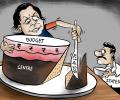
Every option before the finance minister comes with a price tag, observes T N Ninan.

The high profitability of India's corporate sector should buffer the costs of rupee appreciation.

Moody's expect RBI to hold policy 'repo' rate steady to have a neutral stance in this growth

The government hopes of registering GDP growth rate ranging between 6.1-6.7 per cent in 2013-14.

'These provisions may even be seen to be a threat to burgeoning businesses, since they would view every announcement of a rate cut as a starter's pistol that triggers a long race to adjust prices and to justify the adjustment,' argue Rashmi Deshpande and Anjali Krishnan.

If they can sit together and hammer out 'Black Sea Initiative' deal for much needed food shipments, surely, they should be able to address the madness of the larger military conflict?

Indian service sector output broadly stabilised in September but remained in the contraction zone as incoming new business fell moderately due to the damaging impact of the pandemic on demand, leading to more job losses.
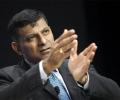
The Indian economy has "some bright spots and a number of very dark stains" and the government should target its spending "carefully" so that there are no huge deficits, noted economist and former RBI Governor Raghuram Rajan said on Sunday. Known for his frank views, Rajan also said the government needs to do more to prevent a K-shaped recovery of the economy hit by the coronavirus pandemic. Generally, a K-shaped recovery will reflect a situation where technology and large capital firms recover at a far faster rate than small businesses and industries that have been significantly impacted by the pandemic.

Says high inflation has to be reversed to achieve sustainable GDP expansion.
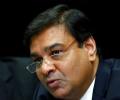
Lower inflation, FCNR(B) outflows likely to influence central bank decision

The budget-making exercise offers golden opportunities despite challenges, observes Shankar Acharya, former chief economic adviser to the Government of India.

The main factor boosting production was a sustained rise in new work inflows.

Not only is gold a hedge against currency depreciation, rising crude prices and uncertainty, it is up 7 per cent (in dollar terms) in the past 12 months, says Devangshu Datta.

And why markets could give up 25 per cent of all these gains made since March 2020

There is little sense in trying to find stocks that will not be vulnerable in a situation where 87% of the market is trending down and India is getting set for a crucial election, says Devangshu Datta.

If the Centre and states are keen on spending more to meet the COVID-19 challenges in the coming year, they must bear in mind the need to raise more resources through taxes and non-tax revenues, suggests A K Bhattacharya.

The country has been facing an ever-rising fiscal deficit, increasing debt and a hamstrung economy.

Employees of some top Indian companies were in for a pleasant surprise when they received a mail from their HR team announcing a hike in salaries and bonuses. Led by IT firms and start-ups, HR managers say that while some have offered cash and stock options, others are in a wait-and-watch mode and add the trend will pick up in other sectors. For example, IT giant Cognizant - which had an attrition rate of 19 per cent in the December quarter - has established a $30-million employee retention fund in order to bring down the high attrition rate.
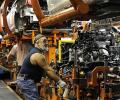
Regarding employment, the manufacturing sector hiring remained broadly unchanged.

Onions had the highest inflation rate among all major commodities.

Macroeconomic management is usually a lot more comfortable with lower fiscal deficits. The sooner we get there, the better for the economy, says former Chief Economic Adviser to the Government of India Shankar Acharya.
An action on the rate front is unlikely to figure in Rajan's plan for the moment.

RBI also retained its GDP growth forecast at 7.6 per cent

The rupee rallied for the second straight session by gaining 21 paise to end at 66.10 against US dollar.
The longest winning streak was the six years between 2002-2007 when the Nifty moved from around 1,000 to over 6,000.

RBI has taken a balanced approach in the credit policy considering various developments across the globe and their near term impact.

A normal monsoon, softer interest rates and inflation, pent-up demand, along with mild budgetary support may help growth pick up in coming quarters.

There are glaring anomalies with Indian data and that could lead to wrong policy prescriptions.

Investors still seem to have a disinflation bias to their thinking.

Despite a slowing economy, the Budget does not envisage any major stimulus through the budgeted fiscal deficit figures, said Goldman Sachs.

The finance ministry and RBI must get less conservative and improve co-ordination.

'As the growth momentum reverses benefiting from re-monetisation, it will be accompanied by a rise in inflation.'

'If businesses are focused on de-leveraging, they can hardly be investing. This is the price extracted by investment mistakes during UPA rule, and should have been foreseen. 'But Modi-I must share the blame, for muted reform of the financial sector, partisan policy in telecom, the harm done to exports by an over-priced rupee, and so on,' says T N Ninan.

The Reserve Bank may cut key interest rates as early as this week.

Business activity contracted in Q2 FY20, the first contraction since 2013-14 and the second since the 2008 global financial crisis, report, Abhishek Waghmare and Anup Roy.

The finance minister's meeting with chief executives and managing directors of banks ahead of the Union Budget assumes significance in view of the critical role the banking sector plays in boosting consumer demand across sectors.

It also painted a grim possibility of any major gains in the rupee during the current fiscal saying that the continuing global volatility, and domestic political uncertainty ahead of the 2014 hustings will limit chances of any significant appreciation apart from further impact growth.

Encouraged by softening inflation, the RBI on Thursday decided to cut the benchmark interest rate by 0.25 per cent to 7.75 per cent with a view to boost growth.

As a model of transport, the A380 strikes a parallel -- a shared fragility -- with giant container ships, observes Shyam G Menon.

Analysts expect modest recovery in Indian economy.
